
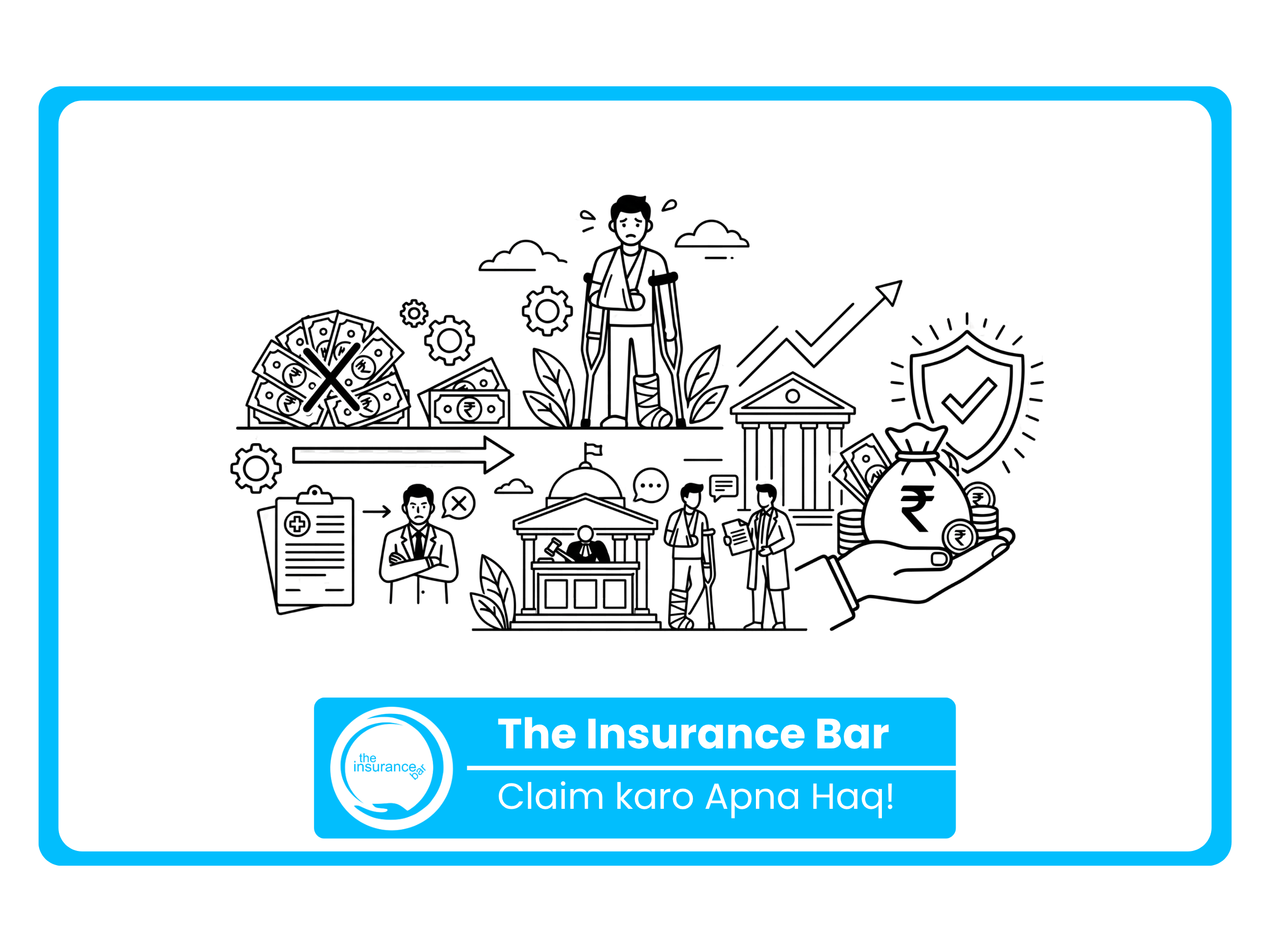
A policyholder holding a Personal Accident Policy submitted a Temporary Total Disability (TTD) claim for 8 weeks of medically advised bed rest following an ACL tear surgery. The insurer short-settled the claim for only 4 weeks without providing contradictory medical evidence or citing specific policy exclusions. By escalating the matter to the Consumer Disputes Redressal Commission (DCDRC) under IRDAI guidelines, the policyholder successfully recovered the remaining ₹2 Lakh balance.
Case Snapshot
| Metric | Details |
| Claim Amount | ₹4,00,000 (8 weeks at ₹50,000/week) |
| Cover Amount | ₹50,000 per week (Temporary Total Disability) |
| Diagnosis | ACL Tear & Meniscus Damage |
| Rejection Reason | Short-settlement with unspecified justification |
| Forum | Consumer Disputes Redressal Commission (DCDRC) |
| Outcome | Remaining ₹2,00,000 recovered (Total ₹4 Lakh paid) |
| Resolution Time | 10 Months |
Background
Mr. Abhinandan held a Personal Accident Policy featuring a Temporary Total Disability (TTD) benefit of ₹50,000 per week. In April 2025, he sustained an ACL tear and meniscus damage due to an accidental fall.
He underwent corrective surgery in June 2025 to repair the joint. Post-surgery, his treating physician mandated strict bed rest, pain management, and physiotherapy for a continuous period of 8 weeks.
Following his rehabilitation, Mr. Abhinandan submitted a claim for ₹4 Lakh. This amount was calculated precisely based on the 8-week medical advisory multiplied by the ₹50,000 weekly TTD benefit specified in his policy schedule.
Unique Information / Rejection Reason
In September 2025, the insurance provider, [Insert Insurer Name], issued a final settlement letter approving only ₹2 Lakh. This effectively compensated the policyholder for just 4 weeks of recovery time instead of the documented 8 weeks.
The remaining balance of the claim was rejected without providing a clear, factual rationale. The insurer did not submit an independent medical evaluation to contradict the treating doctor’s certificate.
Furthermore, the settlement correspondence failed to invoke any specific policy clause that limited the TTD coverage duration for this specific surgical procedure.
Documents Reviewed
To build a comprehensive evidentiary record, the following documents were analyzed:
- Policy schedule detailing the Temporary Total Disability coverage limits
- Hospital admission records and surgical notes
- Treating Doctor’s Certificate (dated 25 June 2025) explicitly mandating 8 weeks of rest
- Physiotherapy and post-operative treatment logs
- The insurer’s final settlement and repudiation correspondence
Legal Analysis / Why the Rejection Was Challenged
Under the IRDAI (Protection of Policyholders’ Interests) Regulations, insurers generally need to support claim deductions with concrete evidence. They are required to clearly explain the basis of any repudiation or short-settlement in their official correspondence.
An insurer cannot arbitrarily override a qualified medical practitioner’s advisory without providing a counter-assessment from an independent medical examiner. Deducting claim amounts based on vague internal guidelines, rather than documented medical facts, generally constitutes a deficiency in service under the Consumer Protection Act.
If you are reviewing a vague settlement letter and need clarification on your policy terms, exploring legal precedents or utilizing analytical resources from The Insurance Bar can provide valuable direction.
To legally justify a short-settlement, an insurer must explicitly state the policy clauses applied and provide clear reasoning. Vague deductions deprive the policyholder of the opportunity to address the insurer’s concerns constructively or provide additional supporting evidence.
Strategy Adopted & Outcome
To challenge this discrepancy, the complete evidentiary record was organized to highlight the timeline of medical events against the corresponding policy entitlements.
The matter was formally brought before the Consumer Disputes Redressal Commission (DCDRC). The legal representation focused strictly on presenting the uncontradicted Doctor’s Certificate alongside the precise TTD clauses outlined in the policy document.
When presented with the organized documentation in a legal forum, the insurer was unable to substantiate the arbitrary 4-week deduction. Ultimately, the DCDRC proceedings resulted in a complete recovery of the remaining ₹2 Lakh, ensuring Mr. Abhinandan received his full ₹4 Lakh entitlement.
Frequently Asked Questions (FAQs):
Can an insurer short-settle a Temporary Total Disability (TTD) claim?
Yes, but they must provide clear justification based on policy limitations or provide independent medical evidence that contradicts the treating doctor’s advice.
What should I do if my claim is approved for a lesser amount without explanation?
You should formally request a detailed breakdown and ask the grievance cell to specify the exact policy clauses relied upon for the deduction.
Does a doctor’s certificate guarantee the full duration of a TTD claim?
While a doctor’s certificate serves as primary medical evidence, the insurer processes the claim according to the maximum financial limits and conditions specified in your policy schedule.
What constitutes a “deficiency in service” in insurance claim settlements?
Failing to provide clear reasons for deductions, ignoring valid medical evidence without justification, or violating IRDAI guidelines on fair practices generally qualifies as a deficiency in service.
Leave a Reply