
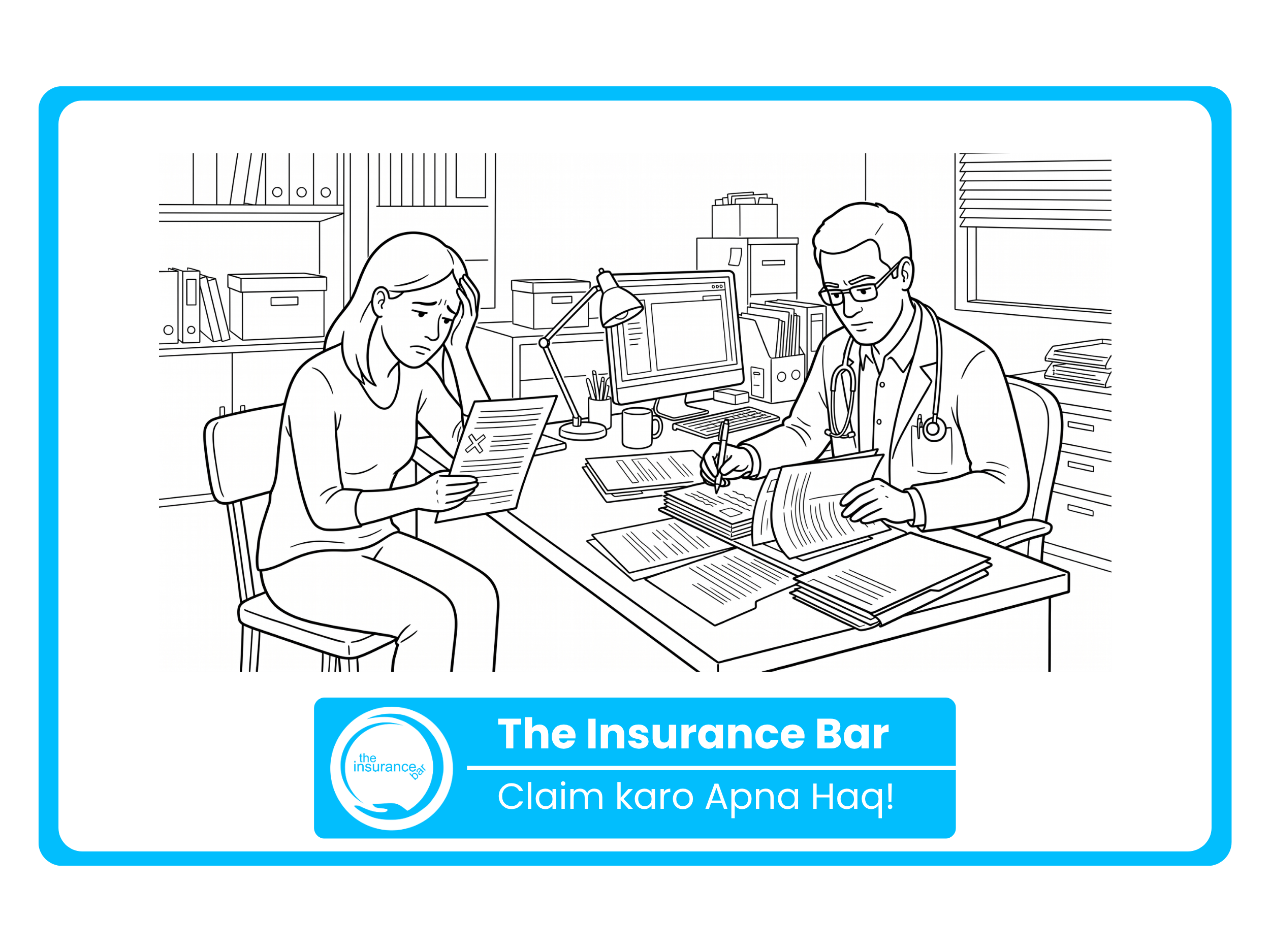
Many policyholders assume that once they honestly disclose their medical details and submit all treatment documents, their health insurance claim will be processed fairly.
But in reality, even a single incorrect line in a hospital record or discharge summary can sometimes lead to a health insurance claim rejection.
For policyholders, this can become deeply frustrating, especially when they later try to correct the mistake but still face rejection.
When a Hospitalization Leads to an Allegation of Misrepresentation
Cases like these frequently arise for policyholders who hold comprehensive family health insurance policies.
In many instances, policyholders are admitted for acute symptoms requiring immediate medical evaluation. Following evaluation, patients are often diagnosed with conditions like hypertension or urinary tract infections (UTI).
After hospitalization, the medical expenses are submitted to the insurer for cashless approval or reimbursement.
However, insurers often repudiate such claims, alleging that the insured had an undisclosed pre-existing history of the condition for several years. They claimed this amounted to a “misrepresentation of facts” simply because the indoor case records and discharge papers allegedly mentioned a past history of hypertension.
In such situations, obtaining a doctor’s certificate clarifying that the duration mentioned in the discharge summary was a clerical error is the recommended remedy. Yet, despite reviewing this clarification, the insurer maintained the repudiation.
What Policyholders Should Know About Medical Paperwork
One important lesson from such cases is that policyholders should carefully review hospitalization records and discharge summaries whenever possible.
Even small documentation mistakes can later create severe complications during claim assessment. If a genuine clerical or human error is identified, obtaining prompt clarification from the treating doctor becomes extremely important.
In many health insurance misrepresentation disputes, the core issue is not intentional concealment by the policyholder, but rather how insurers rigidly interpret inconsistencies in medical paperwork.
Fighting Back Against Misrepresentation Allegations
A rejection based on a hospital error is not the final word. To fight back, you must focus on whether the insurer fairly assessed the clarification and surrounding medical records before continuing the repudiation.
This involves carefully examining hospital records, discharge summaries, doctor clarification certificates, claim documents, policy wording, and email correspondence.
For wrongfully denied policyholders, the next step is to challenge the repudiation before the Insurance Ombudsman or a District Consumer Disputes Redressal Commission. The strategy focused on demonstrating that the disputed entry was specifically clarified by the treating doctor, highlighting that clerical errors should be properly examined, and organizing the complete evidentiary record.
Sometimes, a single mistaken entry in a medical paper can unfairly change the entire direction of a genuine insurance claim. Claim Karo Apna Haq.
Learn how The Insurance Bar helps policyholders navigate complex medical evidence and fight unfair claim rejections to secure the compensation they deserve.
Frequently Asked Questions (FAQs):
Can a hospital error really cause a health insurance claim rejection?
Yes, insurers often rely heavily on discharge summaries and indoor case records. A single clerical error, like an incorrect duration of a medical history, can lead insurers to allege misrepresentation of facts and deny the claim.
What should I do if my discharge summary has a mistake?
You should carefully review your documents and immediately obtain a prompt clarification or certificate from the treating doctor explaining that the entry was a human or clerical error.
How can I fight a rejected health insurance claim due to misrepresentation?
You must organize your complete evidentiary record, question the insurer’s review of documents, and escalate the issue to the Insurance Ombudsman (which typically resolves disputes within 30 days) or the District Consumer Disputes Redressal Commission.
Leave a Reply